|
|
| |
|
| CONNECT WITH MIDDLEWEB |  |
| |
|
|
|
 |
 
|
Many states have enacted restrictions on cellphones in classrooms, but is that enough? A story in today's Technology & Connected Learning section looks at efforts to expand such bans throughout the school day.
Also in the issue, ideas from one educator on using multigenre picture books in the middle grades, and a story that looks at tips on preventing burnout from the country's top teachers.
|
|
| |
 |
| (Pixabay) |
With the rise of thumb-typing on mobile devices among students, some schools are placing renewed emphasis on keyboarding skills. Teachers are integrating keyboarding practice -- now being viewed as an essential job skill -- into the curriculum, sometimes as extra credit and sometimes as a requirement, to ensure students develop these critical skills early.
|
|
|
Multigenre picture books that blend nonfiction topics with poetry offer middle-school students a unique reading experience, educator Kasey Short writes. These books combine facts, poetic language and visuals to engage students in complex issues and encourage deeper inquiry, supporting a range of learning styles and academic levels, making them ideal for differentiation, Short writes.
|
|
|
|
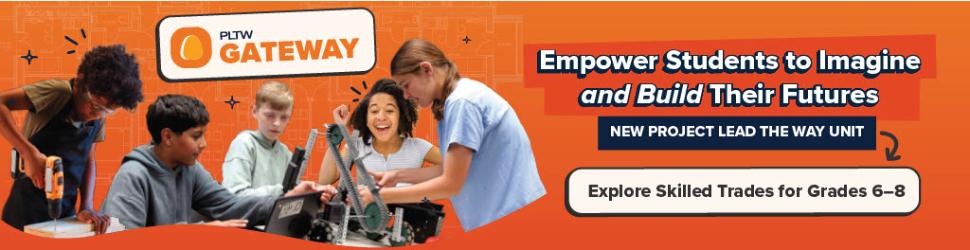
Demand for workers in skilled trades is expected to rise about 10% by 2033. Give teachers what they need to let students explore professions in plumbing, construction, and energy with Building for the Future, the newest unit for grades 6-8 from Project Lead The Way (PLTW).
|
|
|
| ADVERTISEMENT |  |
|

|
Elise Choi, a high-school junior and policy director for the youth-led advocacy group GENup, calls for the integration of digital wellness into California's health education curriculum. In this commentary published during National News Literacy Week, Choi highlights the mental health challenges posed by digital media and artificial intelligence and calls for practical skills to manage digital consumption.
|
|
|
| |
 |
| (Utah778/Getty Images) |
Teachers can enhance classroom stability and student engagement by using anchor tasks, which are daily or near-daily routines and activities that provide predictability and structure, writes high-school librarian Benjamin Barbour, who also teaches government, history and research. These tasks support a positive learning environment, help teachers with lesson planning and can serve as formative assessments, Barbour writes
|
|
|
A study by SRI Education finds that, while teachers use high-quality instructional materials, most lessons achieve only surface-level comprehension. Only 24% of observed lessons fostered robust comprehension, integrating literal and inferential understanding. The study suggests that systemic practices often inadvertently limit deeper learning. To address this, SRI recommends defining a vision for robust comprehension, reorienting professional learning around meaningful texts and aligning assessment systems to prioritize deep understanding.
|
|
|
| Technology & Connected Learning |
|
|
The momentum behind school cellphone bans has led over half the states to enact some form of restriction, with some considering daylong bans to improve student achievement and mental health. Despite widespread adoption, a University of Southern California study shows that compliance is inconsistent, with most students continuing to use phones during school hours.
|
|
|
| |
 |
| (Pixabay) |
School district initiatives often fail not because of a lack of good ideas, but because of challenges with implementation, write Kathy Pierandozzi,, a special-education leader, and Dana Godek, CEO of EduSolve. The authors outline the Awareness-Prevention-Intervention Framework, which they suggest using to build organizational capability, focusing on awareness, prevention and intervention.
|
|
|
Finalists for the National Teacher of the Year award share strategies for preventing burnout, emphasizing the importance of finding joy, building meaningful connections and prioritizing self-care. They highlight the need for administrators to create supportive environments, trust teachers and value their time, as well as encourage project-based learning and advocate for students.
|
|
|
| ICYMI: The Most Popular Stories From Our Last Issue |
|
|
| What if every teacher taught media literacy |
More state legislatures are developing media literacy policies in response to debates over student phone use, social media restrictions, and artificial intelligence. But are they committed to supporting programs that engage all teachers in opportunities to teach media literacy? Read on. |
|
| Authentic inquiries using gummy bear science |
Kathie Palmieri's fifth graders loved her gummy bear activity. It transformed a standard lab into an opportunity for authentic inquiry. It shows that even the simplest materials can lead to big scientific thinking - especially when paired with a question that invites wonder. Read more. |
|
|
| Got this from a friend? Subscribe now and stay in the loop! |
|
 |
|
| |
| I know there's still a chance, and as long as there's a chance, I will try. |
Lindsey Vonn,
alpine ski racer |
|
| |
 |
|
|

|
|
|
|
|
|
| Copyright © 2026 SmartBrief. All Rights Reserved. A division of Future US LLC. |
| Full 7th Floor, 130 West 42nd Street, New York, NY, 10036. |
|
|
|
|

.png)